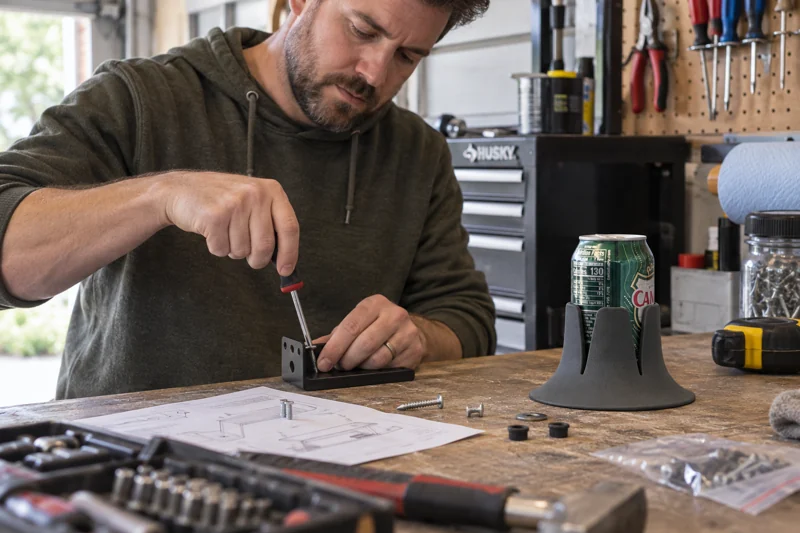
Finally, somewhere to put your drink at the workbench.
4.9 from 119 Steadi reviewsA wide, low base that grips the bench top, the tool-chest lid, or the cast-iron saw table — no magnet, no clamp, no hole cut into anything. It holds your coffee, water bottle, or tumbler steady right where the work is.
Get one for the bench — $14.95One flexible piece, nothing to snap or unclip — rinse it clean. 30 real shop days to prove it, free shipping from Orange, CA.
Check what's on the bench right now — the sticky note test is below ↓

Been there
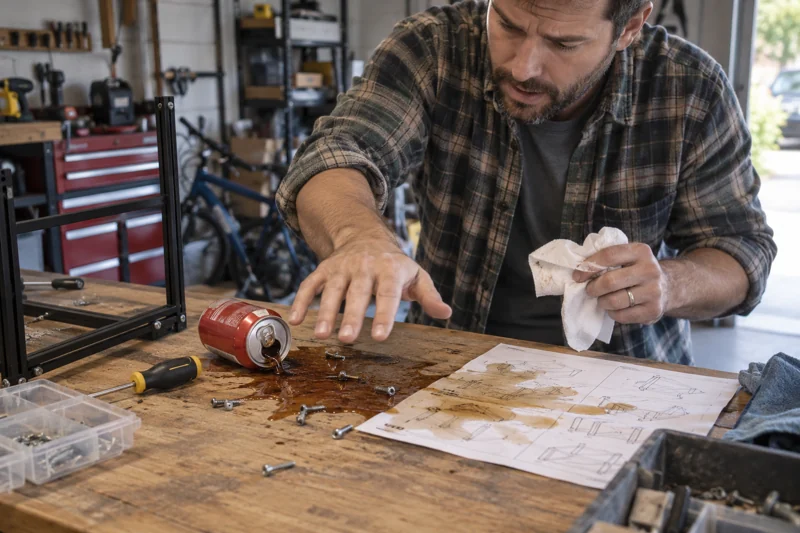
This is a normal week at the bench.
The panel swings into position while cauls and squeeze-out cover the top, and the coffee parked in the last open corner is exactly what gets caught — the glue's open time is running out, so there's no pausing to save it.
The random-orbit sander has hazed the air, the open cup at the tail of the bench has picked up a film, and the last swallow is grit — 'sawdust in my coffee' is a running joke in this hobby for a reason.
The water sits on the tool-cart lid while you're on your back underneath — every slammed drawer and every roll of the cart nudges it a little nearer the edge, and you surface reaching for it blind with one greasy hand.
The worst possible day for a drink at elbow height: one documented spill of coffee with cream onto raw walnut plywood ended with a single piece of advice online — sand it out, or buy a new sheet.
The project's done and the can sweats on the cast-iron wing, or on the fresh finish, while you stand back and look at the work — the ring it leaves is what Saturday morning finds instead of you.
Under the hood
Built to grip the hard stuff too.
A vibrating top or a cluttered working edge gives a narrow-based cup nothing to stand on. The wide, low base spreads its footprint across whatever's underneath instead of balancing on a point.
Flexible fins hold the drink from the sides by its bottom inch, so a bump or a jolted drawer doesn't walk it toward the edge.
A sander runs, a board swings past, someone leans on the bench — the wide base keeps its weight low, so it rocks instead of letting it lean, and brings the drink back level.
Fit, the easy way
Skip the tape measure — the shop already has the gauge.
lands in here
A square sticky note: 3 inches, exactly — the same ceiling that decides what stays upright on the bench.
The classic square is exactly 3 inches on a side. That's a fact about sticky notes — and it happens to be the exact ceiling of what fits.
Wherever it's sitting today — the tool-chest lid, the saw wing, the open corner of the top — look at the bottom, not the rim. Tumblers taper and rims flare; the base is the only measurement that matters.
Base sits inside the square? It fits. Hangs over the edges? Too wide. A tiny puck lost in the middle — under 2 inches? Too narrow.
No calipers, no spec sheet, no guessing at the hardware store. One sticky note, one glance, with the cup that's actually on the bench.
Will mine fit
The bottom inch decides what survives the shop.
The rule is one line: a container base 2 to 3 inches across settles in. Every verdict below follows from it.
- 30 oz insulated tumbler (Yeti Rambler class) fits
- 40 oz Stanley-style tumbler fits
- Water bottle with sip lid fits
- 28 oz Gatorade bottle fits
- 12 oz beer can fits
- 16 oz energy drink can fits
- 32 oz gas-station coffee cup fits
- Handled coffee mug handle in the way
There's a floor as well as a ceiling — under 2 inches the base sits too loose. The handled mug is the honest exception: the base measures in range, but the handle lands exactly where a fin needs to grip, and it's one more thing to snag on bench clutter besides.
The full fit database — Stanley, Red Bull, Yeti, and 30 more, with sourced base measurements →
The pitch, honestly
Three reasons it earns a spot on the bench.
Holds steady on hard shop surfaces
The wide, low base grips wood, painted steel, and bare cast iron at least as well as it grips anything soft — no magnet for the tool-chest lid, no clamp for an edge, no hole drilled into the bench.
Takes the coffee cup, the can, or the 40 oz tumbler
The coffee cup, the tumbler, the can, the water bottle with a sip lid — cans and bottles slide on, cups and tumblers drop in through the fins and get gripped by the bottom inch, so a tall 40 oz tumbler settles in instead of leaning.
Belongs next to the tools, not on top of them
One piece of matte flexible material — nothing that scratches a tool-chest finish or leaves a fixed hole in a bench top. It moves from the saw table to the cart to the sawhorses in a second and stows flat in a drawer when the shop closes up.
Compared to the workarounds
The shop has already tried to solve this, with mixed results.
| A magnetic toolbox cup holder | The Workbench Cup Holder | |
|---|---|---|
| On a wooden or MDF bench top | Nothing to grip — needs bare steel, not wood or MDF | Grips wood, painted steel, and bare cast iron alike |
| Fits what you actually set down | One fixed opening, about 3.3 inches — too wide for some bottles, loose for others | Settles anything with a base about 2 to 3 inches across |
| A slammed drawer or a hard bump | Side-mounted on one magnet — a hard knock can shear it off | Rocks with the surface, low and wide, and settles back down |
| Mounted right on the tool-chest lid | Exactly the spot it's built for — grips the steel fine | Holds steady there too, same base as everywhere else |
| On the bare cast-iron saw table | No vertical steel to grip — nothing to mount to | Sits and grips there too, no mount needed |
| Moves from bench to cart to sawhorses | Stuck wherever the steel is — can't follow the project | No mount — goes wherever the work is that day |
| Cost | One more toolbox add-on — another purchase to justify | One small piece, not another accessory to buy |
They grip only vertical ferrous steel, so a wooden bench top, MDF, sawhorses, or an aluminum cart offer nothing to hold on to. The common fixed opening runs around 3.3 inches, which misses both ends — one reviewer reports a Gatorade bottle too wide to drop in, while a slimmer bottle just rattles loose. Reviews on the category leader flag durability as mixed, and because it holds by a side magnet, a hard bump can shear the cup straight off — one buyer's tumbler dropped before he realized the protective tape was still covering the magnet.
Built for a rail or a boat gunwale, so on a flat bench top they can only grab the one edge available — putting the drink cantilevered exactly where hips, elbows, and boards travel. They're well reviewed in the scenes they're made for; a flat bench isn't one of them.
A whole folk genre of hole-sawed cup recesses, wooden blocks, and printed brackets exists for exactly this problem. Every version shares the same limits: fixed in one spot, shallow enough that a tall tumbler still levers out, and the recess doubles as a sawdust trap.
Only fit benches that have dog holes to begin with, and they occupy a hole the clamps might need next — sitting wherever the grid happens to land, not wherever your hand actually goes.
From the reviews
What buyers say.
Recent reviews of the Steadi, from every room and rig it lives in.
I have a tendency to spill my drinks and have two cats. This is one of the best things I’ve ever impulse bought. It works. It actually works. It’s a heavy, wide enough base that it is actually stable. My “spot” in the living room is near a somewhat-cushioned fabric ottoman, which is where I usually put my drinks. It’s
Dixie · 2026-08-30I love mine. I just wish the price was more appropriate. $15 seems a lot for a small plastic item. Reduce it to $9.99 and free shipping and I'll buy a few more!
Carolyn G. · 2026-08-27Excellent!
Brian S. · 2026-08-27Thank you for your service!
Brian S. · 2026-08-27It’s great love it
gilbert a. · 2026-08-24I never knock over my water at night anymore!
Customer · 2026-08-21All 119 reviews are for the drink base itself, collected across every place people use it.
Why more than one
Two identical tumblers on the bench. Whose is whose.
Two people working the same glue-up end up with two identical steel tumblers parked in the same open corner — same size, same shape, a coffee ring starting on both. Nobody wants to grab the wrong one with sawdust on their hands. Two bases, two colors, planted where each one belongs, and the guessing ends before it starts.
Build your set
Give everyone their own.
Pick a pack, then give each one a color — so nobody has to ask which drink is theirs.
The fine points
Asked over sawdust, answered here.
Does it actually work on a hard workbench top?
Hard, flat ground is exactly what it's built for — wood, painted steel, and bare cast iron all give the wide base and the fins the same grip a soft surface would. Bump it and it settles back down instead of sliding toward the edge.
Will it scratch or mark the tool-chest lid?
No magnet, no clamp, no metal touching the paint — it's one piece of flexible material sitting on top, so there's nothing to scuff the finish the way a magnet's edge or a screw-on bracket can.
What about the cast-iron saw table? I keep it waxed.
It sits on top the same as anywhere else and doesn't add moisture of its own. Keeping a sweating can inside it instead of loose on the iron is exactly the point — the base holds the drink steady and resists tipping, so a bump is a lot less likely to send a full can rolling across the wax.
Will my tumbler fit?
Measure the bottom, not the top. A base of 2 to 3 inches across fits — the 40 oz Stanley does. A handled coffee mug doesn't; the handle gets in the way of the fins.
Does it keep sawdust out of my coffee?
No — it holds the cup steady, it doesn't cover it. If dust in the drink is the bigger worry, pair it with a lidded bottle or tumbler; even then, shop regulars will tell you a sip lid picks up its own film of dust over a long session.
Does it bolt to the bench or need dog holes?
No. Nothing clamps to an edge, mounts in a dog hole, or bolts through the top. It sits on whatever surface is open that day and moves with the project.
My sander and chop saw shake the whole bench. Does that end it?
Vibration is just what a running shop sounds like, and it's exactly what this is built to shrug off. The base's low, wide weight keeps it settled as the top shakes, and it rocks and settles instead of walking off the bench. It resists tipping — though a direct hit from a swung board is still a direct hit.
Does it work on sawhorses, or only a real bench?
Anywhere flat — the bench top, the tool-chest lid, a sheet of plywood across sawhorses, even the concrete floor in a pinch. It has no fixed mount, so it goes wherever the work is that day.
How do I clean it?
Rinse it, wipe it down, or put it in the dishwasher. It's one piece of flexible material with nothing to come apart and nowhere for sawdust to hide.
Who makes it, and where do I buy one?
It's called the Steadi, molded in small runs in Orange, California by Steadi Labs — veteran-founded and patent pending. Every order ships free from steadilabs.com, with 90 days to change your mind.
A month of real shop days.
Run it through a month of real shop days. If it doesn't do what this page says — on the bench, the tool-chest lid, the saw table, with your cups — email hello@steadilabs.com and it gets made right. No forms, no fight.
Veteran-founded · Patent pending · Made in Orange, California
The maker
Made in a small shop, not a big factory.
The maker is Steadi Labs, a small veteran-founded company in Orange, California — its own shop, running its own machines. It's injection molded in small runs, and nothing about it travels far: the mold, the material, and the color runs all sit within about three and a half miles of that shop. The people who make it read hello@steadilabs.com themselves, same as anyone who keeps a bench of their own.
Keep the coffee off the toolbox lid.
The drink stands wherever the work is that day — bench top, tool-chest lid, sawhorse rail — and the toolbox paint stays exactly as clean as you left it.
Get one for the bench — ships freeCheckout runs through steadilabs.com — that's Steadi Labs, the company behind it.